Diabetes
Trigger finger is more common in people with diabetes and may involve more than one digit.
A painful finger or thumb that clicks, catches or locks can often be treated without a hospital or ambulatory surgery center. For appropriate patients, trigger finger release can be performed in our orthopedic office using local anesthesia.
No general anesthesia. No hospital or surgery-center facility fee for an in-office procedure. Orthopedic offices in Decatur, Snellville and Loganville. Se habla español.
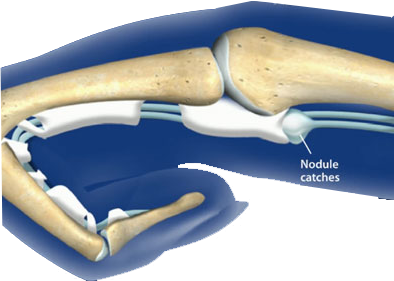
Trigger finger anatomy showing the flexor tendon, A1 pulley and catching nodule.
Understanding the Condition
Trigger finger—also called stenosing flexor tenosynovitis or a trigger digit—occurs when a flexor tendon does not glide smoothly through the tendon sheath at the base of the finger. The A1 pulley normally keeps the tendon close to the bone. When the tendon or surrounding sheath becomes thickened, the tendon can catch beneath the pulley.
The result may be a painful click, pop or snapping sensation as the finger bends and straightens. In more advanced cases, the finger may lock in a bent position and require the other hand to straighten it. The thumb can be affected as well.
Trigger finger is different from a tendon rupture. The tendon is usually intact; the problem is restricted gliding through a tight area.
Symptoms & Risk Factors
Many patients cannot identify one specific cause. Repeated gripping may aggravate symptoms, but trigger finger can also develop without a clear activity-related trigger.
Trigger finger is more common in people with diabetes and may involve more than one digit.
Thyroid disease—particularly low thyroid function—has been associated with a higher risk of developing trigger finger.
Rheumatoid arthritis and other inflammatory conditions can affect the tendon sheath and increase the likelihood of trigger finger.
Call an orthopedic office promptly if the finger cannot be straightened, function is rapidly worsening, or the hand is red, hot or markedly swollen. A recent injury, open wound, fever, numbness or change in finger color may require urgent medical assessment.
Orthopedic Evaluation
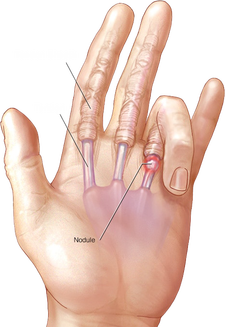
Trigger finger is usually diagnosed by listening to the symptoms and examining the hand. The doctor may feel tenderness or a small nodule near the A1 pulley while asking the patient to bend and straighten the finger.
An MRI is generally not required. X-rays do not show the tendon catching, but they may be used when arthritis, injury or another source of finger pain is suspected. Ultrasound is occasionally helpful when the diagnosis is uncertain.
Treatment Options
The best treatment depends on the severity and duration of symptoms, whether the digit is locked, prior treatment, medical conditions such as diabetes, and how much the problem interferes with work and daily activities.
One of the biggest advantages of trigger finger treatment at Atlanta Bone & Joint is that, for appropriate patients, the release can be performed directly in the orthopedic office under local anesthesia. You remain awake, the hand is numbed, and the tight A1 pulley is released through a small incision.
Reducing painful gripping, using a night splint and taking an anti-inflammatory medication when medically safe may help mild or early symptoms. Hand therapy may be recommended when stiffness is present.
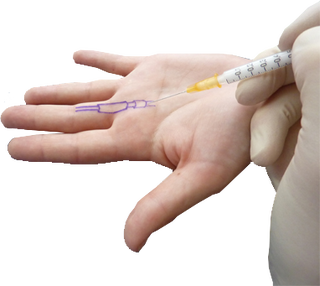
A corticosteroid injection around the flexor tendon sheath can reduce inflammation and improve tendon gliding. It is commonly performed in the office and may be offered during the evaluation when appropriate.
When the digit remains locked, symptoms continue after nonsurgical treatment, or recurring triggering limits hand function, an office-based release under local anesthesia may provide a direct treatment option without scheduling a hospital or ASC procedure.
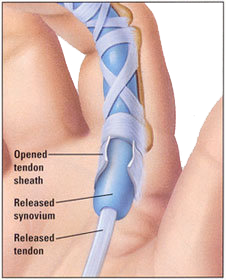
The skin and operative area are numbed with local anesthetic. Through a small incision near the base of the affected finger, the surgeon opens the tight A1 pulley so the flexor tendon has room to glide. The pulley is released—not the flexor tendon itself. Because appropriate cases can be treated in the office, general anesthesia and a separate hospital or ambulatory surgery center visit may not be necessary.
Cortisone injections may be less predictable in people with diabetes and can temporarily raise blood sugar. Patients with diabetes should discuss glucose monitoring and the most appropriate treatment plan with their physician.
Frequently Asked Questions
Yes. For appropriate patients, Atlanta Bone & Joint can perform trigger finger release in the orthopedic office using local anesthesia. This avoids a separate hospital or ambulatory surgery center facility fee and usually avoids an anesthesia-provider charge. Your surgeon will determine whether an office procedure is appropriate after examining the hand and reviewing your medical history.
No. Trigger finger is a tendon-gliding problem at the A1 pulley. Arthritis affects a joint. The two conditions can occur together, which is one reason an examination is useful.
Yes. Mild symptoms may improve with activity modification, splinting or an injection. Surgery is generally reserved for persistent, recurrent or locked trigger fingers.
Usually not. The diagnosis is commonly made from the history and physical examination. Imaging may be considered when another condition is suspected.
Yes. When the thumb is involved, the condition is often called trigger thumb. The same basic tendon-and-pulley mechanism is involved.
Surgery may be considered when the digit remains locked, symptoms substantially limit function, or nonsurgical treatment does not provide lasting relief. The decision is individualized.
Symptoms can recur after nonsurgical treatment. Recurrence after a complete surgical release is less common, but no procedure can guarantee a particular result.
Convenient Orthopedic Care
Atlanta Bone & Joint Specialists evaluates hand and finger conditions at three convenient offices. Choose the location that works best for you, or call for help finding the first available appointment.
Related care: Carpal tunnel syndrome · Tennis elbow · All office locations
Clicking, Catching or Locking?
Get a clear diagnosis and an individualized plan. Cortisone injections may be available when medically appropriate, and selected patients can have trigger finger release performed in the office under local anesthesia—without a hospital or ASC facility fee.
This page provides general educational information and does not replace an examination or personalized medical advice. Treatment recommendations and recovery vary by patient.