
About Meniscus Tears
|
Meniscus tears are among the most common knee injuries. The meniscus functions as a shock absorber between the two bones in the knee The meniscus helps dissipate pressure to protect the cartilage vital for painless knee function. Meniscus tears occur in many ways, shapes and forms. They usually are caused by a pivot injury in the knee. The knee swells immediately and when you walk you may hear popping or you may feel catching and locking within the knee joint. An understanding of a few terms is important.
Meniscus Repair- when the surgeon uses stitches to put the torn meniscus back together Menisectomy- when the surgeon removes part of the torn meniscus to make the joint move smoothly Cartilage- the meniscus is a form of cartilage, but it is not articular cartilage. In fact the meniscus acts to protect the articular cartilage. Many people refer to meniscus tears as cartilage tears. |

A patient with a possible meniscus tear after feeling a catching like episode.
|
When do we fix meniscus tears?
|
In most patients under the age of 30, meniscus tears are usually repaired using stitches if possible. In patients over 35, it is extremely unlikely that the meniscus will be repaired unless an ACL tear occurs at the same time. In patients over 50, partial menisectomy is done after cortisone and physical therapy have failed. Some meniscus tears can't be repaired while others can. Have your surgeon discuss the tear pattern with you so you have a better understanding of which procedure would be best for you.
|
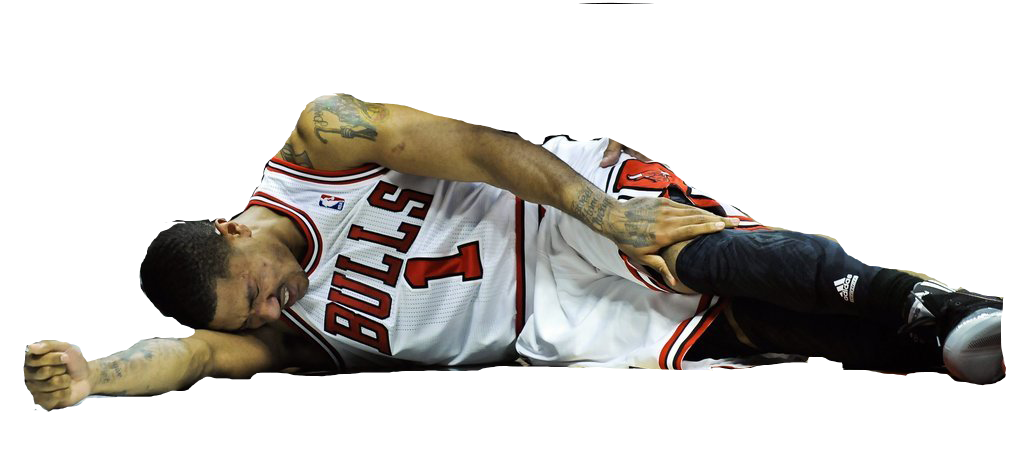
Chicago Bulls star Derrick Rose tore his meniscus and had it repaired once and then re-tore and they then had to remove the torn meniscus
|
What does a meniscus tear look like?
The meniscus, when seen from above looks like a C shaped structures. The meniscus can tear in any pattern. Below you can see the different tear patterns.
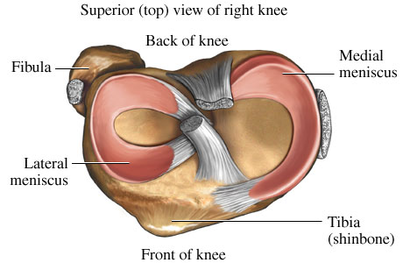
A view of the medial and lateral meniscus from above. Notice how both menisci are C-shaped.
|
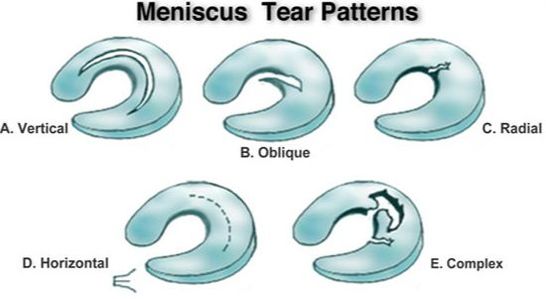
Although this shows meniscus tear patterns, there are still more variants.
|
The Locked Knee- Bucket Handle Meniscus Tears
|
One meniscus tear variant is called the bucket handle tear. This is a tear pattern that causes the knee to lock and not bend. It is considered a surgical urgency as it limits motion. Surgical intervention is imperative to restore motion and stability. Watch the video to see more about the infamous bucket handle meniscus tear that causes a locked knee.
|
|
Meniscus Repair Video
|
|
|
Rehabilitation
Rehabilitation after meniscus surgery varies. If part of a torn meniscus is removed (menisectomy), physical therapy with no restrictions is initiated within 3-4 days of surgery. If the meniscus is repaired, usually, the patient must wear a special brace that keeps the knee straight but allows early weight bearing (walking). However, there are restrictions on bending the knee, meaning that unless in therapy or not putting weight on the leg, will we allow the knee to bend.
General meniscus repair protocols involve avoiding bending the knee past 90 degrees for 2 months, walking with the leg in extension (fully straight), and a return to sport at 4-6 months depending on the tear pattern and repair.
General meniscus repair protocols involve avoiding bending the knee past 90 degrees for 2 months, walking with the leg in extension (fully straight), and a return to sport at 4-6 months depending on the tear pattern and repair.

- Prior blood clot or pulmonary embolus
- the #1 predictor of having another clot
- the #1 predictor of having another clot
- Factor 5 Leiden
- Von Willdebrands disease
- Venous Statsis
- Extensive immobilization after surgery
- Lower Extremity surgery
- Oral Contraceptive Birth Control